Core sectors

Six sectors. One energy group.

Six core sectors, each with its own engineering discipline, its own supply chain and its own delivery model. Most of our projects combine more than one.

Six core sectors, one delivery standard.

The Group connects international technology providers, investors, contractors, and government stakeholders to develop commercially viable energy projects in Qatar and international markets.

01

Oil & Gas

Development and support of projects across the upstream, midstream, and downstream value chain, including equipment, specialised services, processing infrastructure, and industrial partnerships.

  • Upstream, midstream and downstream project development
  • Equipment supply for oil and gas facilities
  • Specialised services
  • Processing infrastructure
  • Industrial partnerships
02

Power & Utilities

Development of conventional and hybrid power-generation projects, utility infrastructure, electrical systems, and energy solutions for government, industrial, and commercial clients.

  • Conventional and hybrid power generation
  • Utility infrastructure
  • Electrical systems
  • Energy solutions for government, industrial and commercial clients
03

Renewable Energy

Solar photovoltaic systems, solar thermal solutions, wind and hybrid technologies, energy storage, smart lighting, BIPV, and utility-scale clean-energy projects.

  • Solar photovoltaic systems
  • Solar thermal solutions
  • Wind and hybrid technologies
  • Energy storage
  • Smart lighting and BIPV
  • Utility-scale clean-energy projects
04

Energy Infrastructure

Engineering, procurement, construction, installation, commissioning, operations, maintenance, and specialised infrastructure supporting energy and industrial facilities.

  • Engineering, procurement and construction
  • Installation and commissioning
  • Operations and maintenance
  • Specialised infrastructure for energy and industrial facilities
05

Industrial & Local Manufacturing

Establishment of manufacturing and assembly projects that support local-content objectives and strengthen regional energy supply chains.

  • Establishment of manufacturing projects
  • Assembly projects
  • Support for local-content objectives
  • Stronger regional energy supply chains
06

Energy Transition & Technology

Energy efficiency, decarbonisation, smart monitoring, digital energy management, sustainable mobility, and emerging clean-energy technologies.

  • Energy efficiency
  • Decarbonisation
  • Smart monitoring and digital energy management
  • Sustainable mobility
  • Emerging clean-energy technologies
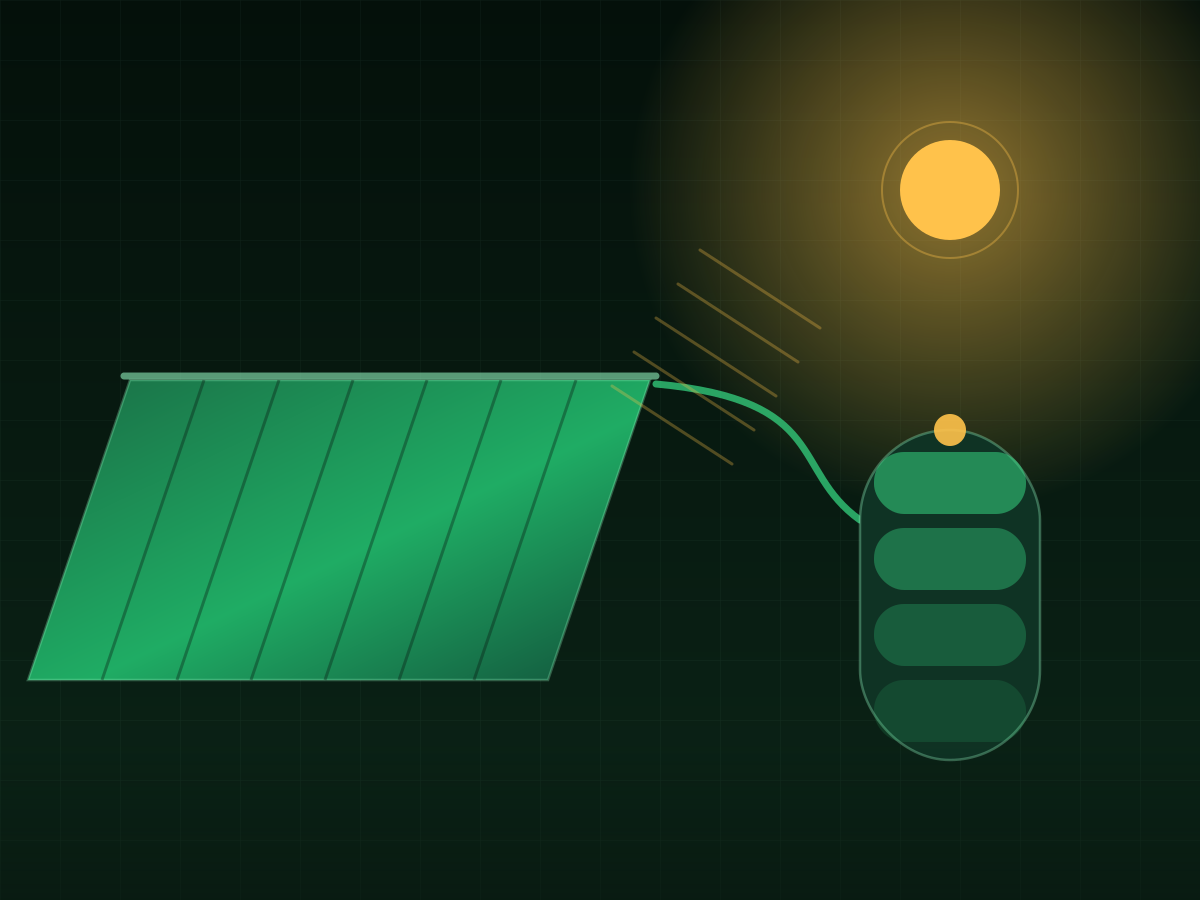
Rooftop photovoltaic array on a commercial building

Photovoltaics

Grid-tie, off-grid and hybrid PV plants on free fields, rooftops and covered structures. Modules are sorted to extreme efficiency and current tolerances so every string and every section of the plant is tuned to the limit.

  • Grid-tie systems from 2 kWp to megawatt scale
  • Stand-alone systems with lithium or lead-acid energy storage
  • Carports, canopies, bus shelters and covered walkways
  • Rigid crystalline and flexible thin-film modules
  • String and central inverter architectures with remote monitoring
Solar thermal collectors feeding a hot water tank

Solar thermal water heating

High-quality flat plate collectors and stratified tanks sized for the real daily draw of a building — residential towers, hotels, labour accommodation, sports facilities and industrial process heat.

  • Systems from 750 to 76,000 litres per day delivered
  • Thermosiphon and forced-circulation configurations
  • Stratified storage with electric or district backup
  • Polysun simulation of draw profiles before sizing
Autonomous solar LED street lighting

Solar lighting

Autonomous solar LED streetlights and flood lights with robust European components — no trenching, no cable, no metered consumption. Deployed on highways, reservoirs, parks, bus stops and remote pumping stations.

  • 360° PV fixtures at 22.5% module efficiency
  • Ground or wall mounting, dust-proof enclosures
  • Mobile plug-and-play units for temporary sites
  • Hybrid grid-assisted units where autonomy is critical
Building-integrated photovoltaic facade

Building-integrated photovoltaics

PV that is the building envelope rather than an addition to it — façades, roofs, ceilings, windows and curtain walls. Cell colour, spacing and transparency are specified with the architect, so the array reads as cladding and generates at the same time.

  • Thin-film BIPV windows and golden-toned crystalline BIPV
  • Cell colour variation and transparent module options
  • Artistic shading that reduces interior cooling load
  • The first vertical BIPV tower in Qatar — Falcon Tower
Small-scale wind turbines

Wind energy

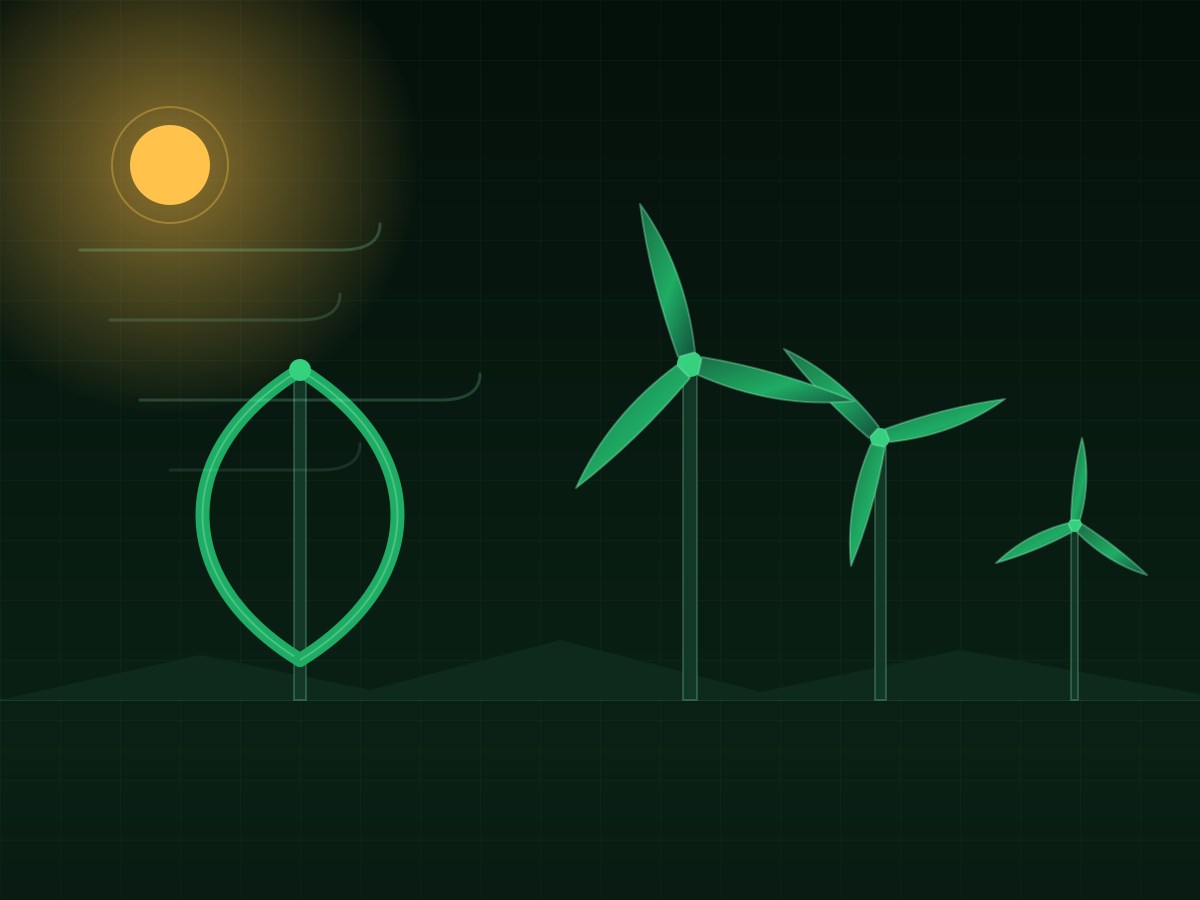
Small-scale wind sized for the site — a complement to solar in hybrid installations, or a standalone source where the wind resource carries the load. Every mast is preceded by an output simulation and a feasibility analysis.

  • Wind systems from 300 W to 50 kW
  • Small vertical axis turbines from 300 watts
  • Small horizontal axis turbines from 500 watts
  • 30 m masts at 10 kW each — Kahramaa Awareness Park

The technologies the transition actually runs on.

Clean energy technology was a USD 788 billion market in early 2023 and investment in it is projected to roughly quadruple by 2030. Five technologies carry more than 80% of the world's remaining emissions-reduction potential. These four set the direction of the market our sectors sit in.

Solar and wind

Wind and solar generated a record 13.4% of the world's electricity in 2023. Innovation is running towards larger turbine outputs and recyclable module materials — which is why we specify against current module and inverter generations rather than a standing catalogue.

Carbon capture, utilisation and storage

CCUS can capture 85% to 90% of the CO₂ produced by power plants and heavy industry — the only lever that decarbonises an existing hydrocarbon asset without shutting it down. Qatar is targeting more than 11 Mtpa of capture capacity by 2035.

Hydrogen and blue ammonia

Clean hydrogen production costs are expected to fall by around 50% through 2030, and Gulf national oil companies stand to earn as much as USD 200 billion from green hydrogen by 2050. Qatar's blue ammonia plant — the world's largest — begins production in 2026.

Efficiency and electrification

Energy efficiency and electrification are consistently among the largest investment categories in every clean-energy forecast, because they cut demand before a single new megawatt has to be built. In the Middle East they draw the second-largest share of projected clean-energy spend.

The region carries the resource to match: MENA receives 22–26% of all solar energy reaching the earth and could supply at least half of global electricity consumption. The Middle East is also set to spend USD 2 trillion on construction by 2035, where sustainable techniques can cut life-cycle emissions by 50–60%. Source: Cleantech in Qatar, Invest Qatar, August 2024 (IEA, IRENA, PwC, BCG, World Bank).

The national programmes our sectors are built to serve.

Six published programmes define where Qatar's energy spending goes between now and 2035. Each maps onto work we already deliver.

Renewable generation

Qatar is targeting 4 GW of renewable capacity by 2030 and 1,675 MW of solar generation under the 2024 National Renewable Energy Strategy, on top of the 800 MW already running at Al Kharsaah. Utility-scale, commercial and distributed PV all sit inside that number.

Carbon capture, utilisation and storage

The national target is capture capacity above 11 million tonnes of CO₂ a year by 2035 — the single largest decarbonisation lever available to a hydrocarbon economy, and the reason our oil and gas and energy-transition sectors are run as one conversation.

Energy efficiency and demand reduction

Kahramaa's Tarsheed programme and the national 25% greenhouse-gas reduction target by 2030 drive demand-side work: metering and monitoring, retrofits, solar thermal displacing electric water heating, and efficient lighting.

Electrified transport

The Ministry of Transport is moving the public bus fleet to 100% electric by 2030 while Kahramaa installs 1,000 charging points. Charging infrastructure needs canopies, feeders, storage and autonomous lighting — the work we already deliver for Mowasalat and Ashghal.

Waste-to-energy and the circular economy

The Ministry of Municipality's 2024–2030 strategy adopts smart waste management systems and the conversion of waste into energy, and the Integrated National Solid Waste Management Program has been running since 2022. Waste-to-energy is a generation asset like any other — fuel handling, a thermal cycle, a grid connection and an operator.

Green and certified buildings

More than 250 LEED-certified projects are already complete in Qatar, and Msheireb Downtown Doha — the world's first sustainable downtown regeneration — targets a 32% energy reduction. Building-integrated PV, solar thermal and façade shading are specified at design stage, not retrofitted.

Programme figures from Cleantech in Qatar, Investment Promotion Agency Qatar (Invest Qatar), August 2024.

Structured to match how you fund the asset.

A solar plant can be a capital purchase, an operating cost or a service you simply buy the output of. We contract across the range.

EPC

Turnkey EPC

Engineering, procurement and construction under a single contract — design, supply, installation, testing and commissioning delivered by in-house crews against one schedule and one warranty.

S&I

Supply & installation

Component supply through our European partner network, installed and commissioned to the client’s own prescribed standards where the design is already fixed.

O&M

O&M service contracts

Lifetime operations and maintenance agreements covering monitoring, cleaning, preventive and corrective works, spare parts and performance reporting.

Financing structures are arranged per project. Talk to us before the tender closes, not after.

Which technology fits your site?

The honest answer depends on your roof area, your load curve, your grid connection and your tariff. Send us the site and we will come back with a simulated yield and a payback figure — before anyone asks you to sign anything.

Request a proposal →

Selected projects

From a thousand solar bus shelters to the first vertical BIPV tower in Qatar.